
TL;DR
Everyone rents the same AI models. What makes the answer yours is the context. I built a second brain that an AI agent maintains from everything I read and note, and it made capture and distillation nearly free. Judgment did not get cheaper: the bottleneck is me, and the design has to protect that judgment instead of asking for more of it.
In July 2026 I read a post on LinkedIn by Wim Tobback about the artificial brain he had built, and the visual intrigued me. I saved the post and did little with it.
When I finally came back to it, I read what it was built on: LLM Wiki, a short “idea file” that Andrej Karpathy, co-founder of OpenAI, had published on GitHub in April 2026. Wim Tobback had put that pattern to work. So I was not the only one thinking about this, and there was now a framework to build on.
The core of the idea had been sitting in my mind for some time. I believe lifelong learning is vital, and knowledge is central to my professional activities. I love to connect ideas, people, organisations and frameworks across different fields. So I have been collecting documents, ideas and material for quite some time, but I did not make the time to do something with it.
It was crude oil. MySecondBrain, and the links it draws between everything I put into it, gave me the means to refine it. My work now runs on the high-octane fuel that comes out.
What annoyed me most was that I forgot things or missed an important link. Somewhere in the back of my mind I knew I had read or heard something, but I could not find it again, not in my mind and not in the source. I could not make the link again.
Context, not the model, decides the answer
At the ABISS Summit in Kortrijk on 8 October 2026, Peter Billen, Principal Architect at Google Cloud, put one line on a slide: “The model is not the variable you control. The context is.” That line is important to me. It comes from one of the companies that build the models, the one behind Gemini and DeepMind. Another slide showed a “definition of good”: a card that tells the model what normal looks like for a business figure and from which point it becomes a red flag. Next to that slide I wrote: “We do it every time we prompt. So we need to do that upfront.”
My second brain is that context, written down once. I own both halves of it, the private and the public one. The storage (OneDrive and GitHub) and the model (Anthropic’s Claude) are rented and I could swap either of them easily.
Compiling it once is the refinery for my crude oil. The idea comes from computer science: compiled code runs faster than interpreted code because the translation is done once ahead of time and not on every run.
The word “compile” is Karpathy’s. His gist argues against the usual way of putting a model on top of documents (retrieval per question), where “the LLM is rediscovering knowledge from scratch on every question” and nothing accumulates. He lets the model read each source once, write what it learned into linked pages and answer from those pages afterwards.
Enterprises are reaching the same conclusion. In October 2026 five McKinsey senior partners described for CEOs an “AI operating system” that holds the enterprise’s context. They call it the enterprise’s “second brain” and give it one design rule: “own the context; rent or replace the technology”. That is my OneDrive-and-Claude point, at the size of a company. A Gartner webinar the month before made the same case for agents: “Why do AI agents drift? Not because they lack intelligence. Because they lack context.”
So I hold this as a position, not a finding. Nobody has measured yet that a maintained context beats explaining yourself again in every prompt. My vault has no such measurement, and the peer vaults I have read report page counts, not results. The small evaluation set I built for this article checks that the brain’s answers are grounded in its pages. It does not prove yet that they are better.
Why it matters in a business built on knowledge
Proj3ctS sells judgment, not hours. A client pays for what I have seen work and fail, and for the positions I took on it. My positions, my clients’ history and my reading notes are in no model’s training data. That part of the context only I can supply.
Take a proposal for a new or an existing client. My contribution now sits mostly at the start: thinking about what I captured and the input I got: a phone call, documents and e-mails, or what is publicly available. The first step is to bring that together and have AI draw up a context document that helps me structure and analyse it and come to the synthesis for the proposal. That goes through several revisions. I give the input, let AI do its work, review the output and see where I don’t agree or where information is still missing. Sometimes I go and look that information up, capture it and ingest it so the next version can use it. Once the context document is ready, the same process starts on the slides. For one recent proposal the context document went through three versions and the deck through five, until the fifth had the quality I wanted to send to the client.
The result is a more detailed offer, grounded in my own frameworks and earlier work instead of generic text. It feels faster too. But I haven’t timed it, so the gain I can vouch for is depth and quality.
Two things make that depth possible. The first is finding back what I had lost: a term I half remembered or a framework I applied years ago, with the nuance that made it work. The brain also proposes links between topics I kept in separate drawers. The second is pushback. I like a sharp one-liner. When I put one in a reading note, the brain comes back with context and counter-arguments from my own pages. The opinion survives with a frame around it and a perspective I had not considered.
Whatever drafted the proposal, my name is on it and so is the responsibility. That is the first of the house rules I set for myself and my agents: the brain supplies the context, I supply the judgment.
The frameworks I used
Andrej Karpathy’s LLM Wiki gave me the mechanism. Instead of searching the documents again for every question, the model reads each source once and writes what it learned into linked pages. The next question starts from those pages, so knowledge accumulates. The gist is an idea file, not a product: it describes the pattern and leaves the build to you.
Tiago Forte’s Building a Second Brain gave me the vocabulary and a line I needed. His CODE method (Capture, Organise, Distil, Express) is familiar to many people who have never touched a language model. In my vault the Distil step splits in two: the agent distils the sources and I distil the positions. Karpathy supplied the machine. Forte told me what the machine may not do.
That line answers a warning in the comments under Wim Tobback’s post. Olivier Hens argued that many second brains have become a “data droppoint”: other people’s articles and transcripts with retrieval on top, or in his words a “RAG van interesses”. He wrote that a second brain should hold what is in your own head.
I recognised the risk in my own collecting habit. It becomes just a pile of documents instead of knowledge and wisdom. Karpathy and Tiago Forte were the start of what I built. But much more came as I went, as I thought, reasoned together with my brain and built further on the solution. The frustrations and issues I ran into along the way made me investigate further, look for solutions and build what was needed.
How it is built and what it costs
The build is plain. It has four parts:
- Sources. One folder with everything I put in. The agent may read it but never change it.
- The wiki. A second folder that the agent (Claude Code) maintains: one page per source plus pages for the people, organisations, concepts and projects they mention, all linked to each other. I read it in Obsidian. Git and GitHub keep the history of the public pages.
- House rules. One file the agent reads at the start of every session. When a rule proves wrong I change it and record why in a numbered decision.
- Skills. Repeated work such as taking in a new source or answering a question runs as a skill with fixed steps.
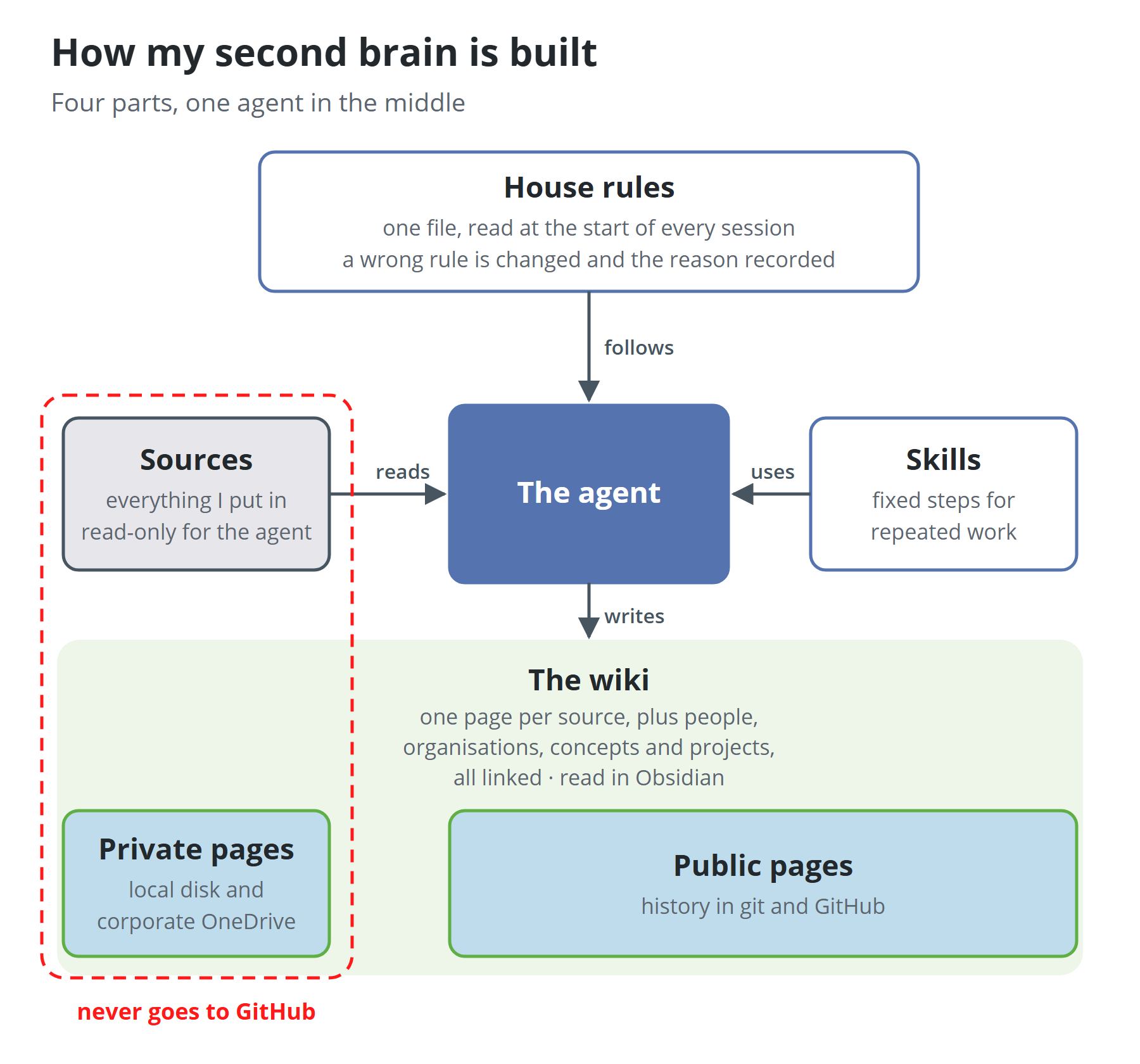
None of this depends on the tool: plain text that I own and rules written down where any agent can read them.
Ingest is what uses the most tokens. A Claude Pro subscription of €18 a month is enough for now, with €20 to €50 in extra credits in months when I process a lot of input. I would like to process in bulk, but then the queue at the bottleneck (me) just gets longer.
Capture is not ingest and privacy is architecture
Getting something into the brain takes two steps, and I keep them apart. Capture costs seconds and involves no judgment. I park a link, a thought or a file in the inbox during a meeting or from another project. Folders I have registered are pulled in automatically. Ingest is where the judgment happens. The agent reads one source per session and proposes what it means. I confirm the takeaways and where each of my notes goes before it writes anything. Sources I tag for it can also be ingested unattended at night on conservative defaults. Anything it cannot decide, it skips. Merging the two steps is how a second brain turns into the pile Hens warned about.
Privacy needed the same kind of separation built into the layout. Two folders never go to GitHub: the sources and the private pages, whether they hold client work or anything else that should stay with me. Git ignores both, the agent checks the list of files before every commit, and forcing a file past that rule is forbidden. For every sentence about a client, one test decides where it goes: would it still be true and knowable if I had never worked there? I did not want confidentiality to depend on anyone remembering to be careful, the agent or me.
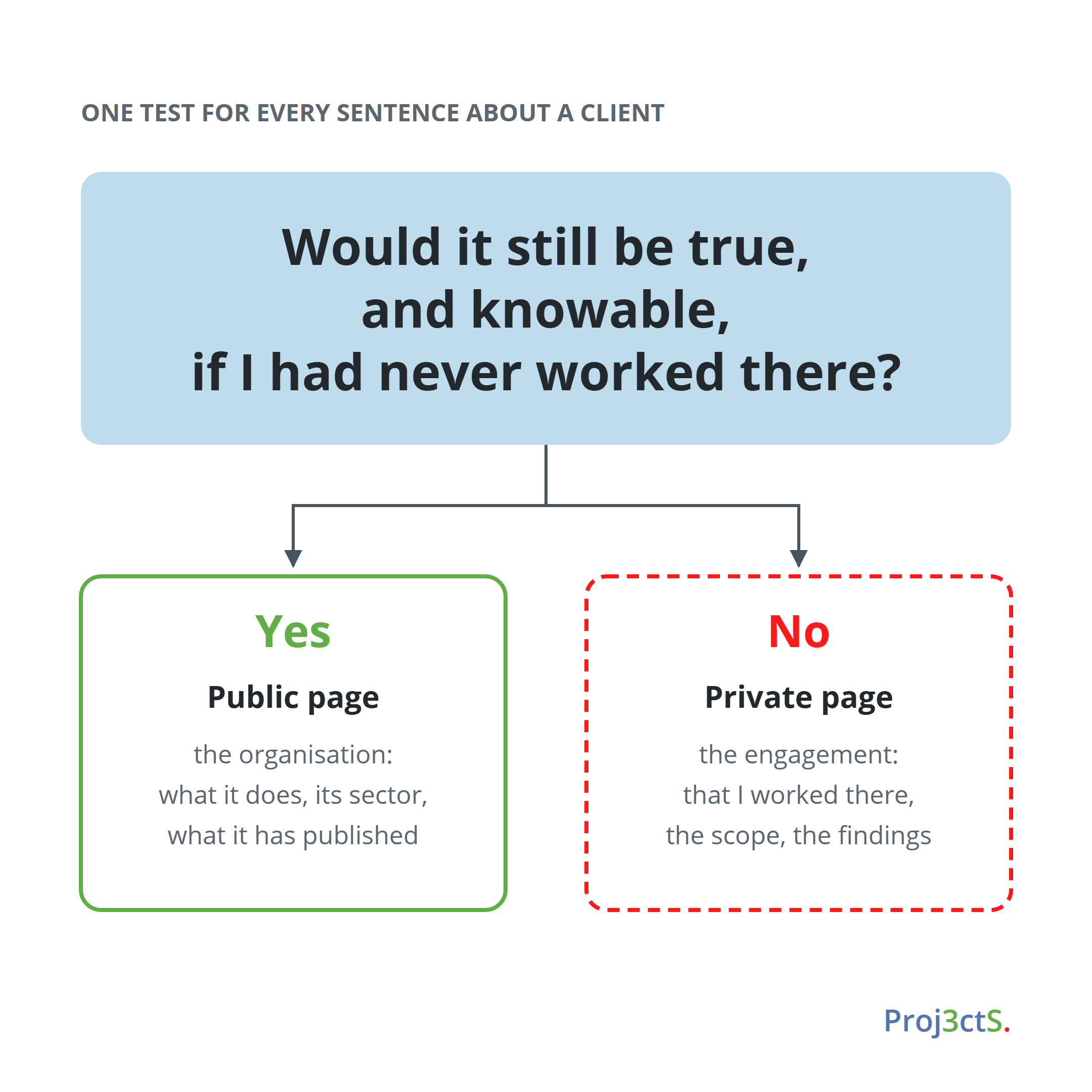
From the start I set the rules on private and public documents fairly strictly. The public part goes to a GitHub repository that is private and accessible only to me, but I still treat everything on it as public. In practice the AI applies those rules very strictly. So far the only exceptions have been cases where I loosened a rule because I knew something that made it fine to publish. It has never happened the other way round: the AI has not once proposed to publish something I preferred to keep private.
The split between private and public is still the most difficult one for me. I want to use as much information as possible to solve business problems, but some information is just not mine to use. Contracts say that general knowledge can be taken to other clients, but with a second brain the detail you carry from personal notes and recollection becomes so much more valuable. I accept the rule because it is the law, obviously. But I also believe in proprietary knowledge. As much as I want to tap into the value others have created, I believe it is due to who created it.
Figures are where I hesitate most. When you write articles and want to make things concrete, figures matter, and many of the figures from my own work are private. When I do use one, I anonymise it or make it vague so the company cannot be traced. But my CV is public on LinkedIn and people can see which clients I worked for. If I refer to a client in the logistics sector, a reader can quickly make the link. At the same time it is impossible to keep everything private. General knowledge is widely spread.
The hardest call was material I left out entirely, from clients I will not even describe here. It was hard because I see a link between every idea and what is already in my brain. That knowledge now stays unconnected to everything else I have.
Review: from junior to medior
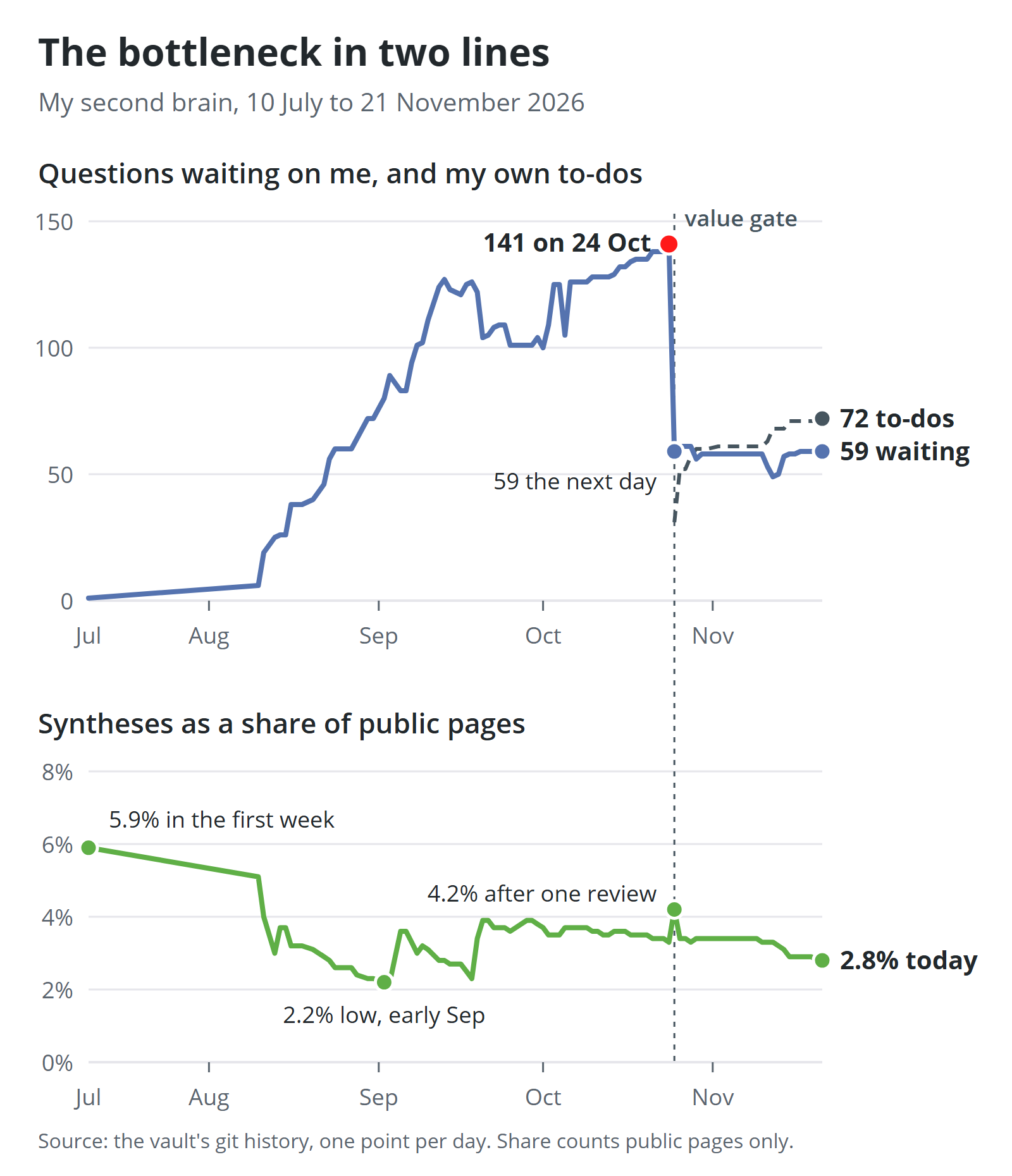
When the agent reads a source it raises questions only I can answer: is this my position, may this be public, is this fact right? Those answers are what make the brain mine. But an agent makes asking almost free, so it asks too much. In late October my list of open questions peaked at about 140.
I started to get frustrated with the amount of work waiting on me. The list kept growing. Every time the brain did something, it reminded me that I was over the limit. It began to feel like I was being pushed. I felt the bottleneck. I also felt that many of the questions did not really need me. In some review sessions I just followed the recommended decision or confirmed a rule that was already in place. I was rubber-stamping.
So I wrote down the rules I had been applying without ever saying them and gave the AI the authority to decide whenever a rule made the answer clear. It also started bundling questions that belonged together so a review session got more done. It felt like going from a junior agent who asked me EVERYTHING to a medior with clear guidelines and the power to decide within them. My time reviewing became more valuable.
The rule I wrote down has two tests. A question goes on my list only if I am the only one who can settle it and if the answer changes something: a page, a position, a rule or an action. Everything else the agent either decides by default where a rule already covers it (with a note I can reverse) or moves to a separate list of things for me to do. One session of sorting took the list from about 140 to about 60. Today it holds 59.
That is no guarantee. A reviewer who skims is not exercising oversight, whatever the process says. I can’t prove this one yet, so take it as my position: review is only worth the attention you bring to it, so the job of the rules is to save that attention for the questions that need it.
My own to-do list has grown. But that is not a problem as long as I work through it by relative priority, as in agile. A longer to-do list is a sign that I am the bottleneck for the growth of Proj3ctS, not a problem with my second brain.
Synthesis: the part I can’t delegate
An agent made capture and distillation nearly free. Positions did not get cheaper. A synthesis (a page that says what I think about a topic) is only written when I direct it and after I have answered the counter-arguments. In the first week 5.9% of my public pages were syntheses. Today it is 2.8%, although I wrote two new ones in the last two weeks. The pages around them grow faster than I take positions. A McKinsey article for strategy leaders put the imbalance in one line: “Analysis now runs on AI time, but judgment still runs on human time.”
I like a bold statement or a one-liner to sharpen a point. I put them in my notes on documents. Based on my brain, the LLM came back with nuance, counter-arguments and sometimes new angles that widened or deepened the concept, so that my comment still fit the model already in my brain. One example was AI governance and loyaal tegendraads, loyal but contrary, from an opinion piece by Bart Derre in De Tijd. Some things contradicted each other. In the end a model came out that kept the human in the loop without undoing the idea of loyal dissent. Far from annoying me, it felt like a gain: I always find it interesting when people come back with well-founded arguments or smart insights. This time it was not a person but a language model that made me think. I adjusted the statement and added nuance. I still believe in it, but written down in a synthesis it needs the right context. By getting feedback and questions my opinion improves and so does the information in my brain. And the outcome (the deliverables and the answers to my questions) is better.
One position is not ready yet: people, process and technology on a data foundation. I have not found the right visual, model or framework to show it to a larger audience. The confidence in my second brain is strong, but in my real brain it is not ready yet. A hand-drawn sketch of it lies on my desk. Only when that is digitised and ingested and the text and the visual say what I want to say will I be sure it is done.
There is a counter-argument I make to myself. Things prepared by AI sit less firmly in my own head. A text I wrote with AI is less anchored in my memory, so I rely more on my second brain to use that knowledge elsewhere. I am creating a dependency and I have to watch it: make sure enough knowledge reaches me too, take the time to read the syntheses, do the reviews, and think critically about what is in my brain. In the end that is part of the value too. What ends up in my own memory is worth more.
Research backs the first half of that worry. Jackson Lu and Anna Zheng (MIT Sloan) and Gerui Zhao (Tsinghua) reviewed the research on generative AI in entrepreneurship in 2026. In one study they cite, 83.3% of people who wrote an essay with ChatGPT could not quote their own essay, against 11.1% of those who wrote without it. Responding to McKinsey’s enterprise “second brain”, Doug Shannon asked the same question: “What happens to the first brain as we build the second?” My answer is a position and a weak one: review feeds the first brain as long as the review is real.
This article is the first piece I wrote that way. Every section starts from a position I took. My own paragraph comes before the agent’s.
What went wrong and why rules end up in code
The agent does not always follow its rules. Neither do people.
Anthropomorphism comes up in several podcasts: the humanising of AI and language models. Some computer scientists argue strongly against it: it is just a text predictor. Others say it sometimes feels very human. That is what I feel too. Some of the behaviour I see is very human. When you lead a team you give people guidelines and work instructions. Sometimes it still goes wrong, by accident or on purpose. When you build an IT system for human users you write some things down in work instructions. When you see those rules being broken you build them into the code so that breaking them is no longer possible. The further an ERP system matures, the more business rules are coded and the more user-proof (even idiot-proof) it becomes. I see the same here. Consciously or not, the language model gets around written rules in certain circumstances. When the rule matters, the answer is to enforce it technically.
One example. Editing a wiki page through the shell can corrupt every accented character and dash in it without a single warning, so I wrote a rule against it. Weeks later a session did it anyway. Today a hook blocks that command before it runs. The rule no longer depends on the agent remembering it.
The rules are strict and they are followed strictly. I noticed the AI broke some rules from time to time, but never on privacy. It corrected itself afterwards and we blocked it technically.
The second example went wrong without anyone noticing. Me included. One rule says the agent reads the full index of the wiki before answering a question. At a hundred pages that was cheap. At more than a thousand the index no longer fits in one read and the agent started searching it for keywords instead. It broke the rule with good intentions: it still found the answer. Nothing reported it. I only learned about it while writing this article. That rule cannot simply be enforced. It has to be redesigned for scale so I keep the benefit of a single overview without paying for its size.
Not every rule deserves a hook. Jan Gevaert, who now runs Ajabu Adventures in Tanzania, once put it in one Dutch line at the top of his blog: “dwarsliggers houden de sporen recht”. A dwarsligger is both a railway sleeper and someone who goes against the grain. Both keep the rails straight. That is my antidote to following rules too strictly. When a rule matters it gets enforced more strictly or it gets changed. What I want to avoid is bureaucracy for its own sake.
What transfers to a team
I built this for one person. Most of the positions behind it were written about organisations. Read together, they give five design principles for anyone who wants to build a second brain for a team or a company.
- Own the context and build it before you need it. Everyone rents the same models. What makes an answer yours is your definitions, your history and your idea of what good looks like. Write that down once where every agent and every new colleague can read it. The storage and the model are rented. The context is the asset.
- One set of rules for people and agents. The rules that matter are about the work: who signs, what may leave the building, what was checked before it was passed on. Those answers do not depend on who wrote the draft. Agents get the same rules plus stricter ones. The rules that matter end up in code.
- Fix the input before you buy speed. AI amplifies whatever goes in and it makes poor work look finished. A team that feeds it unclear sources gets fluent nonsense faster and no error message. The lever is the quality of the information at the start.
- Autonomy is earned and it can be taken back. Let the agent decide more as it proves it can, the way a junior grows into a medior. But a model can lose that competence with one update, so the controls sit outside the agent and the human role is designed, not skimmed.
- Budget the human half. Capture and distillation get cheap. Judgment does not. Someone has to take the positions. That someone is the expert you hired for exactly that. Plan their hours, or the pile grows and the positions don’t.
For you, as a CIO. If a peer CIO asked me how to start tomorrow, I would say: just do it. Get started with structuring your unstructured data. And secondly: do it with a purpose. Because you want to write a blog post, because you need to create a board presentation, because you are creating the department’s strategy.
For your team and your organisation. When I explain it to others, two things are the hardest to get across. You need rules and guidelines: governance matters. And it will require time from the experts. The technology does not replace the experts. It augments them, but it still means work for them. High-quality data and input are needed to get the real value out of a brain or a wiki.
A team brain also meets a problem a personal one never has. Every person’s AI sessions build up their own notes: how a system works, why something broke, where the traps are. None of it reaches a colleague’s sessions. So decide early where each kind of knowledge lives and who keeps it current. Otherwise every person grows a private brain of their own and the team still starts from zero.
An exoskeleton and what it costs the wearer
I picked up the image of AI as an exoskeleton somewhere, during a keynote or in an article. I found it a striking metaphor: AI is not going to replace us, but it can make us stronger. Maybe it also goes back to a keynote I saw a long time ago by Marc Herremans. With his To Walk Again foundation he helps people who cannot walk, through an accident or a condition they were born with, to walk again with an exoskeleton. That may be why the image stuck with me so strongly.
AI is not going to replace us, but it can make us stronger.
As humans we are limited and AI helps us go beyond those limits. We are limited in the number of hours we can be active: we need sleep. We are limited in how much information we can take in: we can read only so many words per minute and listen to only so many podcasts a day. AI, like an exoskeleton, lets us do more than we normally could as humans.
What does that mean for the agenda of an expert, a leader or a manager, as I sometimes position myself? More time should go to capturing input (so more interaction with clients and with people) and to review. The real work (making a presentation, writing a note, working out an idea) is sped up and strengthened by AI. That frees up time. The big question is what you do with that time. Does it go to more work, to more quality, or can I use it for other things? That question has been on my mind lately. I work more now that I work with my second brain and AI. But I also get much more done. I can take many more of my ideas all the way to reality.
I work more now that I work with my second brain and AI. But I also get much more done.
The question is how long that stays sustainable and how I keep it feasible as a person, mentally and physically. The downside of AI making you stronger is that there is much more context switching. The context changes even more than it already did, precisely because AI takes over so much more. I notice that this is sometimes mentally taxing. So it is important for yourself and for myself to set guardrails: take enough time to be physically active, sleep enough and eat healthily. That is also why I recently read Eat Move Sleep by Tom Rath. Jurgen Ingels, entrepreneur and investor, called it his favourite book in his closing keynote at PM Fair 2026. It stresses the importance of exactly those three things.
From crude oil to action
Looking back on four months of building, I would not do much differently. The experimental approach worked well: build something, use it, learn, improve and use the knowledge again.
The most important next step is to make a brain like this work for a whole team instead of one person, effectively and efficiently, without its owner becoming the bottleneck again. The rest of the list is smaller: harder test questions (ones that join two pages or whose answer changed over time), an index that keeps working past a thousand pages and, further out, a brain that also takes in sketches, images and sound.
On day one a goal was honestly not there. Somewhere I had the thought that I would benefit from this later. I was working on blog posts, presentations and board strategies, and I write proposals for new clients. So in the back of my mind it was clear I could use a second brain for that. But only by reading further, building my own and most of all by telling other people what I was doing, did it become clear where the real strength lies. It was not there on day one. It came along the way. But it was always my intention to do more with it than just bring my knowledge and documentation together. That is why experimenting matters to make progress. Learn by doing. Fail fast, fail often, but always fail forward.
Fail fast, fail often, but always fail forward.
People used to say that data is the new gold. Well, data is the crude oil and it has to be refined. For structured data there are other methods and tools, like a data lakehouse. A second brain matters most for unstructured data: documents, texts, presentations. It refines them and you get real knowledge with insights in it. For me the review and the to-dos are the action on top. That is how you go from data and information to knowledge and insights. One of the taglines at Eye on Data is that we go from data to action. The review step and the to-do lists are that action step for me: getting to work with that knowledge.
Data is not the new gold. Data is the crude oil, and it has to be refined.
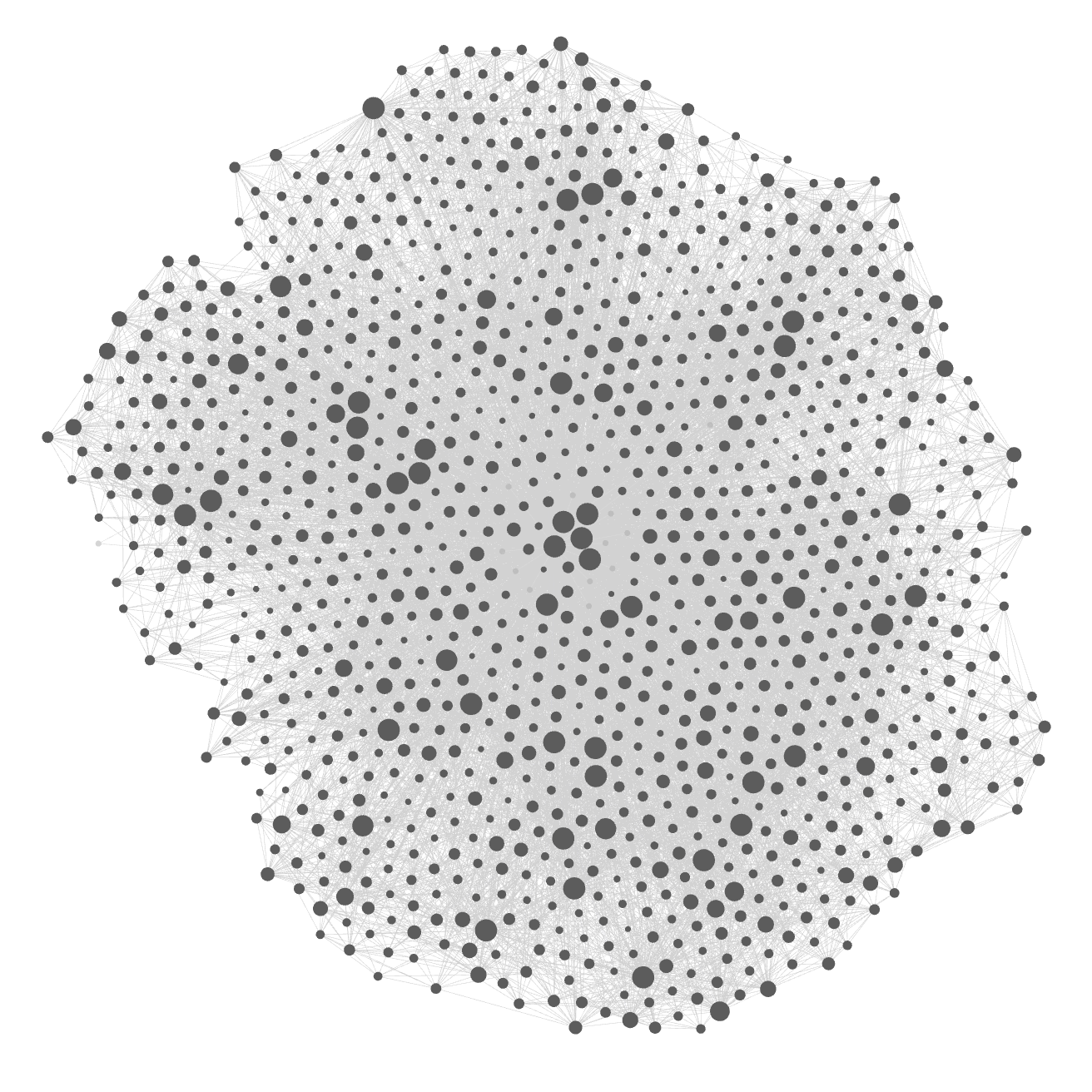
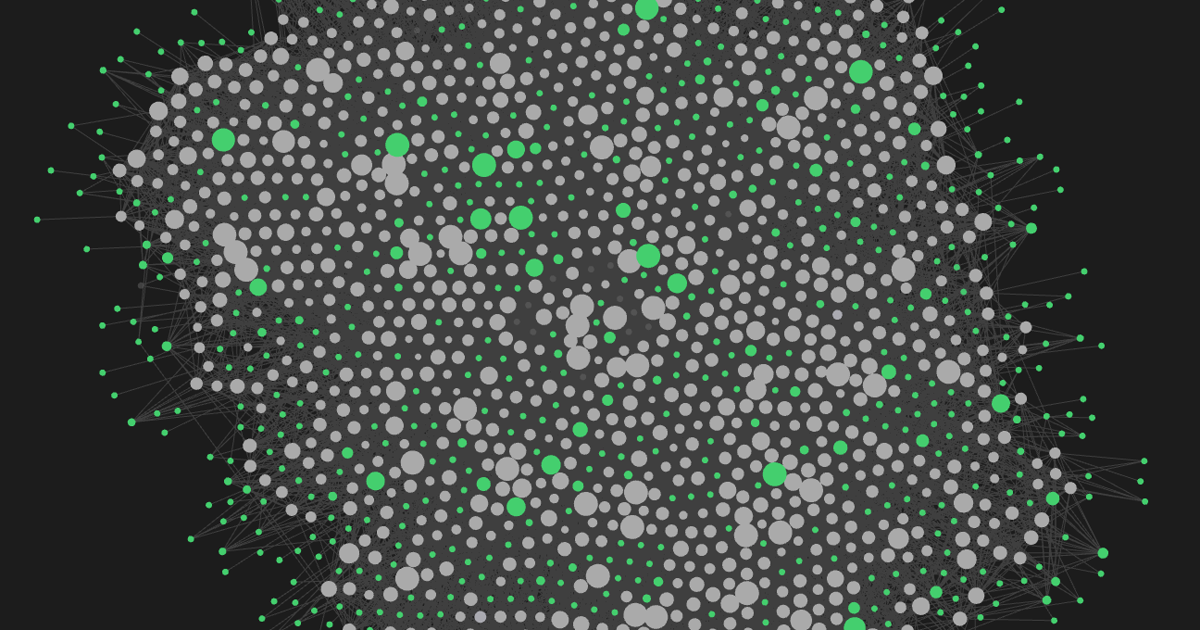
The graph is impressive, but the goal is the new content.
References
- Andrej Karpathy, LLM Wiki (GitHub gist, April 2026).
- Tiago Forte, Building a Second Brain and the CODE method (Forte Labs).
- Wim Tobback, LinkedIn post on his LLM-based second brain, with Olivier Hens’ comment on the “RAG van interesses” (2026).
- Peter Billen (Google Cloud), talk at the ABISS Summit, Kortrijk, 8 October 2026.
- McKinsey & Company, The AI operating system: A new way for CEOs to run the enterprise (October 2026).
- Gartner, Why Enterprise AI Success Depends on Context Engineering (webinar, 22 September 2026).
- McKinsey & Company, The judgment bottleneck: Balancing AI and human speeds in strategy (McKinsey Quarterly, October 2026).
- Doug Shannon, LinkedIn post in response to McKinsey’s AI operating system (October 2026).
- Jackson G. Lu, Anna Manyi Zheng and Gerui Gloria Zhao, Generative AI Use in Entrepreneurship: An Integrative Review and an Empowerment-Entrapment Framework (arXiv 2604.02567, 2026).
- Bart Derre et al., “Organisaties hebben nood aan loyale maar tegendraadse medewerkers”, De Tijd, 18 March 2021.
- Jan Gevaert, blog.
- Tom Rath, Eat Move Sleep (2013).
- Marc Herremans, To Walk Again foundation.